They men in Charlie Company were given black scarves with a red C on them. You will need to reasd the books to get the story of the Charlie Scarf.
I am the wife of a Vietnam Veteran. I am currently writing a book on a battle in Vietnam that took place in 1969. I love to hear stories from the veterans, and enjoy seeing pictures.
Sunday, May 17, 2020
Monday, May 11, 2020
Making sense of my characters
I already told you that I had a spreadsheet about my characters. Did I tell you it ended up being 14 pages long? It was the only way I could keep things straight.
I have men in different platoons, and doing different things. It was a real challenge trying to keep them in groups to make the readers remember them.
I think every character in my book is is unique. Every one is important to me.
I hope you feel the same way when you read the book.
Tuesday, May 5, 2020
So much to learn
So, I have been working on my book for 4 to 5 years. That's not counting the time I spent collecting information from the Veterans.
I'd say most of the first year was spent researching things. Lots of things.
After I learned to decipher the Daily Staff Journal, I moved on to other things. Like, what time does the sun set in Vietnam in March? What does a rice paddy smell like?
What is the jungle like in Vietnam? or the other areas?
There is so much to learn. What weapons do the men carry? What's a claymore? What's C4? What's a Spooky? How do you spell medivac? Medivac or Medevac? (either is correct) booby trap or boobie trap? What kinds of boobie traps are there? What's a Bouncing Betty?
Learn all about these things in my book!
I'd say most of the first year was spent researching things. Lots of things.
After I learned to decipher the Daily Staff Journal, I moved on to other things. Like, what time does the sun set in Vietnam in March? What does a rice paddy smell like?
What is the jungle like in Vietnam? or the other areas?
There is so much to learn. What weapons do the men carry? What's a claymore? What's C4? What's a Spooky? How do you spell medivac? Medivac or Medevac? (either is correct) booby trap or boobie trap? What kinds of boobie traps are there? What's a Bouncing Betty?
Learn all about these things in my book!
Wednesday, April 29, 2020
Tuesday, April 21, 2020
Saturday, April 18, 2020
So many quesions... but how else would I know?
I
begin writing my book by reviewing what the Vets told me. Then I just
start writing.
I
can go back and make it sound better at any time.
But I
cannot get far before I have to do more research. I need details. Lots of
details.
I need
to feel like I am there. That means researching on the internet.
And asking Phil.
I ask
Phil LOTS and LOTS of questions. I want details.
He
says that it was 50 years ago.
Do I
really expect him to remember details?
But,
he does a good job. Some things he thinks about for a while, but every
tidbit he passes on to me is helpful.
And we
look at pictures. They help a lot.
Me: You wore shorts? I didn't know they issued shorts.
Phil: (Laughing) No. We were wearing our underwear. Drab Olive underwear. It was really hot there. And usually we had on boots.
Wednesday, April 15, 2020
Monday, April 13, 2020
M16 Rifle
The M16 rifle is one of the world’s most famous firearms, iconic
as the American weapon of the Vietnam War—and, indeed, as the U.S. military’s
standard service rifle until only a few years ago. But the story of the M16 in
Vietnam is anything but a success story.
In the early years of the war,
the U.S. military had a problem: its primary infantry rifle, the M14, couldn’t
stand up to the enemy’s AK-47s.
he search was on for a
replacement that was lighter weight, more durable, and more lethal than the
M14. After tests and debates , Secretary of Defense
Robert McNamara ordered the adoption of the M16, which was rushed through
production and rushed to Vietnam, reaching troops’ hands in early 1965.
Problems appeared immediately.
Soldiers were often not adequately trained to maintain the new rifle, nor were they always given
cleaning supplies or instructions. The harsh jungle climate corroded the
rifle’s chamber, exacerbated by the manufacturer’s decision against
chrome-plating the chamber. The ammunition that accompanied the rifles sent to
Vietnam was incompatible with the M16 and was the principal cause of the
failure to extract malfunctions. The result was the M16 often jammed, making
the rifle “about as effective as a muzzleloader,” in the words of one officer.
Men were killed in combat
because they couldn’t return fire until the malfunction was cleared. Congress
investigated and the rifle and its ammunition were incrementally modified,
greatly improving its reliability over the next few years. Troop training was
also improved. But the damage to the M16’s reputation could not be undone, and
many soldiers remained deeply skeptical of their rifle through the war’s end.
Friday, April 10, 2020
M60 Machine Gun
Phil Feder with his ammo belts for the M60
The M60 got the nickname
of Pig or Hog because its report sounded like the grunt of a barnyard hog. It
was also the only rifle that could “huff and puff and blow down houses.
Tuesday, April 7, 2020
Help from my Veteran
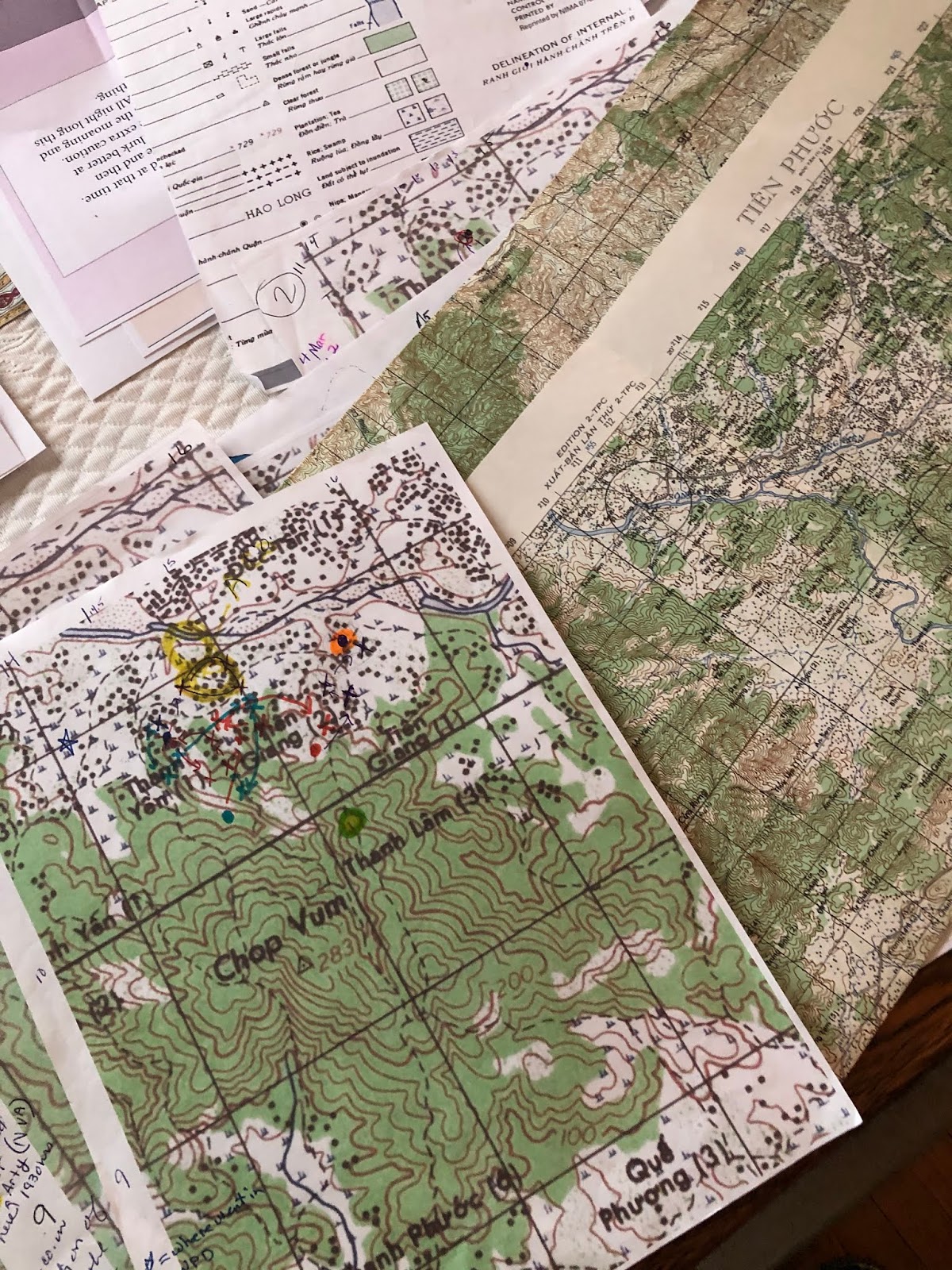
As I'm working on my book I need help from Phil. He says, "Show me on the map. I don't think your right." So, out come the maps. And the coffee table is full. But, now he knows what I am referring to, and he can give me some help. I've studied this maps for hours. Of course, I was right. But he is the one who helped me get things straight. After all, he was there.
On the left is the coffee table in my living room. On the right is some of the maps.
This has become my life.
Monday, April 6, 2020
Sunday, April 5, 2020
Saturday, April 4, 2020
Characters
So, I had an outline of the events, and a list of characters. Then I had to define my characters.
The book is historical fiction. That meant I had the liberty to make up the characters and make up any parts of the story that needed filling in. I did want to stick to the actual events in the battle, and use as many true incidents as I could.
The characters were all made up. Some took on the characteristics of one person, but some of the characters are a mix. I had to make up a background for each one. Were they drafted? How old? Married? Hair color? Special habits? There was so much to consider. I started a spreadsheet, and by the end it was 14 pages long.
I hope I have done the characters justice. They are not real, but they do portray a real story.
The book is historical fiction. That meant I had the liberty to make up the characters and make up any parts of the story that needed filling in. I did want to stick to the actual events in the battle, and use as many true incidents as I could.
The characters were all made up. Some took on the characteristics of one person, but some of the characters are a mix. I had to make up a background for each one. Were they drafted? How old? Married? Hair color? Special habits? There was so much to consider. I started a spreadsheet, and by the end it was 14 pages long.
I hope I have done the characters justice. They are not real, but they do portray a real story.
I realized there were a lot of characters needed.
Friday, April 3, 2020
Did you know?
- The Vietnam war began on November 1, 1955 and ended on April 30, 1975 with the fall of Saigon. It lasted 19 1/2 years.
-Over the duration of the war, more than 58,000 Americans were killed in Vietnam.
- Over the duration of the war over 150,000 Americans were wounded.
- About 30% of Vietnam Veterans have experienced PTSD.
- A CIB (Combat Infantry Badge) means the person was in the infantry an he has seen combat. The Army is suppose to award the CIB to an Infantry soldier who has engaged the enemy or was engaged by the enemy. They are the front-liners under hostile fire in combat zones.
-Over the duration of the war, more than 58,000 Americans were killed in Vietnam.
- Over the duration of the war over 150,000 Americans were wounded.
- About 30% of Vietnam Veterans have experienced PTSD.
- A CIB (Combat Infantry Badge) means the person was in the infantry an he has seen combat. The Army is suppose to award the CIB to an Infantry soldier who has engaged the enemy or was engaged by the enemy. They are the front-liners under hostile fire in combat zones.
Thursday, April 2, 2020
Notebook
My notebook was filling quickly. I had all kinds of notes. Every time a thought came to me I wrote it down. In fact, I had two notebooks started. I think I ended up with five or six notebooks of different sizes, most of them full. Plus several folders full of notes.
Then I started watching videos. Back to the recoilless rifle. I watched them load and fire. I timed it. I watched the explosion. I made more notes. I found the training manual online. More notes.
FIRING THE RECOILLESS
Wednesday, April 1, 2020
Making meaning of the Daily Staff Journal.
I finally had the words in the Daily Journal deciphered. Now, what did they mean?
Of course, my husband was my first resource. He could answer most of my questions. That's a good start. I've got a pretty good idea of the meanings. I need to keep notes. Lots of notes. So, out comes my notebook.
Now I need more accurate descriptions. The internet is great. But, one thing leads to another. A better description, a picture. Learning the technical meaning, then understanding it. Then making sure it is the right definition for the Vietnam War.
For example, I talked about the Recoilless Rifle. I found a 57 mm, 75mm, 90 mm, and 105mm, Which one did they use? Charlie Company used the 90mm (also know as the M67). NVA used the 75mm.
So, every item had to be researched. And notes made.
I already had an outline. Now I needed to update and make sure the outline followed the course of the battle as described in the Staff Journal.
That took a while.
Of course, my husband was my first resource. He could answer most of my questions. That's a good start. I've got a pretty good idea of the meanings. I need to keep notes. Lots of notes. So, out comes my notebook.
Now I need more accurate descriptions. The internet is great. But, one thing leads to another. A better description, a picture. Learning the technical meaning, then understanding it. Then making sure it is the right definition for the Vietnam War.
For example, I talked about the Recoilless Rifle. I found a 57 mm, 75mm, 90 mm, and 105mm, Which one did they use? Charlie Company used the 90mm (also know as the M67). NVA used the 75mm.
So, every item had to be researched. And notes made.
I already had an outline. Now I needed to update and make sure the outline followed the course of the battle as described in the Staff Journal.
That took a while.
90 MM RECOILLESS
Monday, March 30, 2020
Starting my journey
I started writing my book about five years ago. I spent the first year just planning and researching.
After I made my outline and defined my characters, I knew I had to start researching facts.
The first thing I studied was the Daily Staff Journal from their unit. That alone was a challenge as I had to learn all the abbreviations used. I also had to research exactly what they meant.
Take this entry, for example: Fr C Co to TOC RTO: C Co vic BT146108 has revd RR fire from vic BT144107. Neg cas at this time. Arty will fire.
Ok. Some of those words are obvious. Some are not. I learned it meant: From Charlie Company to Tactical Operation Center, Radio Telephone Operator: Charlie Company in the vicinity of BT146108 has received Recoilless Rifle fire from the vicinity of BT144107. Negative casualties at this time. Artillery will fire.
Then I went through every day of the journal to find the activities of Charlie Company and decipher the entries. The battle was March 3 - 10, So I started on March 1 to get a little background.
That was a start, but only the tip of the iceberg.
After I made my outline and defined my characters, I knew I had to start researching facts.
The first thing I studied was the Daily Staff Journal from their unit. That alone was a challenge as I had to learn all the abbreviations used. I also had to research exactly what they meant.
Take this entry, for example: Fr C Co to TOC RTO: C Co vic BT146108 has revd RR fire from vic BT144107. Neg cas at this time. Arty will fire.
Ok. Some of those words are obvious. Some are not. I learned it meant: From Charlie Company to Tactical Operation Center, Radio Telephone Operator: Charlie Company in the vicinity of BT146108 has received Recoilless Rifle fire from the vicinity of BT144107. Negative casualties at this time. Artillery will fire.
Then I went through every day of the journal to find the activities of Charlie Company and decipher the entries. The battle was March 3 - 10, So I started on March 1 to get a little background.
That was a start, but only the tip of the iceberg.
Sunday, March 29, 2020
Vietnam Veterans Day
Today I thank all who served in Vietnam. You are a special group of men.
Can you imagine that this seen is real and not just a movie background? If you consider it seriously, imagine what it would be like to be living this life for a year.
This is from 1968 or 1969.
Saturday, March 28, 2020
Book
Did you ever try writing a book? I did! It's really hard work.
I started writing a book on a specific battle in Vietnam. But, before I go into that, let me give you a little background.
My husband is a Vietnam Veteran. He was in the Army, Americal Division. He was in Vietnam November 1968 to June 1969 when he was wounded. He didn't talk a lot about the war to many people, but he shared some things we me. He also had a couple of Army buddies who lived close enough that we got together occasionally.
So, around 2001 or 2002 he got a call from one of his buddies he had been in Vietnam with. They had started a Charlie Company reunion, and they wanted him to go. I encouraged him, and he went. The next year I went with him. We still go every year. I believe we have only missed one year since then. Most men bring their wives along.
Well, this reunion changed both of our lives. I have never met such a wonderful group of people. It took only a couple of years before I realized how ignorant I had been about the war. The things they talked about were amazing. I wanted to know more. No, I needed to know more.
A few years into the reunion I decided to start taping some accounts from these guys. Their stories were incredible. I was hooked. I could only manage a couple per year.
I became especially interested in a battle that took place on Hill 283, know as Chop Vum Mountain. Charlie Company was involved in that from March 3 - 10, 1969. Alpha Company and Bravo Company were involved sooner.
This story came up frequently, and as they men began talking about it, I became obsessed with learning about it.
So, that brings me back to the book. For many years, I wanted to write a book about the battle at Chop Vum. But, I was a nurse, not a writer. How do you start?
So, after I retired I took a class at the Senior Center on writing. There I met my mentor, Holly Martin.
She motivated me and helped me get started. Without her, I could not have done it.
I am going to talk about my journey in writing on this blog.
Please follow my journey.
Peggy
I started writing a book on a specific battle in Vietnam. But, before I go into that, let me give you a little background.
My husband is a Vietnam Veteran. He was in the Army, Americal Division. He was in Vietnam November 1968 to June 1969 when he was wounded. He didn't talk a lot about the war to many people, but he shared some things we me. He also had a couple of Army buddies who lived close enough that we got together occasionally.
So, around 2001 or 2002 he got a call from one of his buddies he had been in Vietnam with. They had started a Charlie Company reunion, and they wanted him to go. I encouraged him, and he went. The next year I went with him. We still go every year. I believe we have only missed one year since then. Most men bring their wives along.
Well, this reunion changed both of our lives. I have never met such a wonderful group of people. It took only a couple of years before I realized how ignorant I had been about the war. The things they talked about were amazing. I wanted to know more. No, I needed to know more.
A few years into the reunion I decided to start taping some accounts from these guys. Their stories were incredible. I was hooked. I could only manage a couple per year.
I became especially interested in a battle that took place on Hill 283, know as Chop Vum Mountain. Charlie Company was involved in that from March 3 - 10, 1969. Alpha Company and Bravo Company were involved sooner.
This story came up frequently, and as they men began talking about it, I became obsessed with learning about it.
So, that brings me back to the book. For many years, I wanted to write a book about the battle at Chop Vum. But, I was a nurse, not a writer. How do you start?
So, after I retired I took a class at the Senior Center on writing. There I met my mentor, Holly Martin.
She motivated me and helped me get started. Without her, I could not have done it.
I am going to talk about my journey in writing on this blog.
Please follow my journey.
Peggy
Friday, March 27, 2020
Charlie Company Reunion
These men are my heroes!
I have learned so much about Vietnam, especially the Infantry. Until I attended reunions with my husband I had no idea. No idea what it was like in Vietnam. No idea of the daily tragedies they faced. No idea of the bonds they formed.
Now I understand a piece of that. Of course, you cannot fully understand unless you have been there yourself. But, I have come a long way.
It is an understatement to say that these men have changed my life. My hope is that this blog can help everyone become more involved in the history of the Vietnam War. Talk to a veteran. Follow my blog. I am writing a book on a battle in Vietnam.
I have the greatest mentors in the world - Veterans. I have been going through pictures and information and decided I would share it with the world on my blog. If I can enlighten only a few, it will be well worth my time.
I encourage all veterans and their family to share pictures and/or stories, especially from Vietnam.
Subscribe to:
Posts (Atom)
Charlie Scarf
They men in Charlie Company were given black scarves with a red C on them. You will need to reasd the books to get the story of the Charlie ...
-
This is my husband, Philip. Of course, this picture was taken in 1968. He is my hero, and my inspiration. I dedicate this blog to h...
-
They men in Charlie Company were given black scarves with a red C on them. You will need to reasd the books to get the story of the Charlie ...